Introduction to the Path of Clarity
Today we begin a journey toward greater clarity.
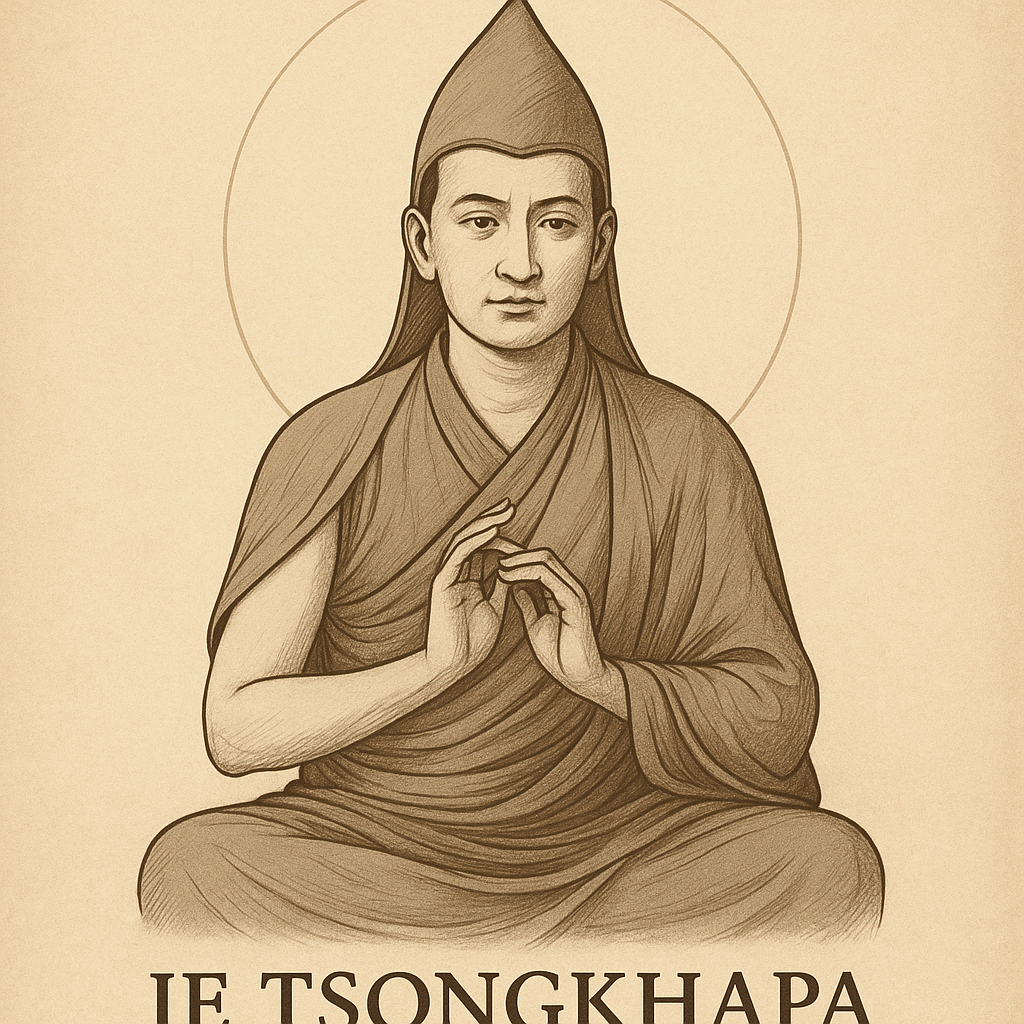
I want to explore a way of living grounded in ethical choices, steady attention, and learning to see ourselves and the world more clearly. The framework I will use is inspired by the teachings of the great Tibetan teacher Je Tsongkhapa, who lived from 1357 to 1419.
Tsongkhapa taught within a Buddhist religious and philosophical tradition. My purpose here, however, is somewhat different. I want to explore what we can learn from his approach in a practical way, without requiring religious belief or ritual.
Think of it as a training program for the mind, much as physical exercise is training for the body.
Three Pillars of Clarity
As I understand and apply Tsongkhapa’s teachings, the path can be organized around three basic pillars:
Ethical Clarity — Living in ways that support peace of mind and reduce unnecessary harm.
Focus Training — Strengthening our ability to pay attention without excessive tension or strain.
Insight — Learning to see more clearly how our minds, our relationships, and our experiences actually work.
The order is important.
We begin with ethics because meditation does not take place separately from the rest of our lives. It is difficult to cultivate a peaceful and attentive mind while continually behaving in ways that create conflict, guilt, resentment, or harm.
So we begin by looking at cause and effect.
Actions have consequences.
The way we speak affects relationships. The way we treat people influences whether they trust us. Anger can damage relationships that took years to build. Dishonesty can disturb our own peace of mind long after the immediate situation has passed.
Ethical living, therefore, does not have to begin with commandments or religious rules. It can begin with a very practical question:
What kind of consequences am I creating through the way I live?
We can also begin to recognize something profoundly human: every person we encounter is as real to themselves as we are to ourselves. They have hopes, fears, disappointments, relationships, and people they love. Remembering this can change the way we relate to others.
Compassion becomes less of an abstract ideal and more of a way of moving through the world.
Creating the Conditions for a Clear Mind
Living ethically creates a more stable foundation upon which we can build our lives. Ideally, the benefits extend beyond ourselves and our families into the larger culture in which we live.
There is an interesting parallel here with the Shambhala teachings of Chögyam Trungpa, who spoke about basic goodness and the possibility of creating an enlightened society. His idea was that mindfulness could help us recognize a fundamental capacity for wakefulness and goodness within ourselves. When expressed through our actions, those qualities naturally affect the people around us.
Whatever terminology we use, the principle is simple:
Inner clarity influences how we participate in the world.
Ethical living also means becoming more aware of habits that interfere with that clarity. Anger, greed, dishonesty, resentment, and habitual self-centeredness can gradually cloud the mind and damage our relationships.
Meditation gives us an opportunity to notice these patterns.
Instead of immediately acting upon every thought or emotion that arises, we learn to observe it.
That small space between experiencing something and reacting to it can become enormously important.
Training Attention
The second pillar is the training of attention.
One traditional meditation practice associated with this training is sometimes translated as calm abiding. The basic principle is straightforward: we practice resting our attention on something simple—often the breath—and notice when the mind wanders.
Then we return.
The mind wanders again.
We return again.
This repeated returning is not evidence that meditation is failing. The returning is the training.
Over time, regular meditation can strengthen our ability to remain present and make us more familiar with the movements of our own minds.
When beginning, short sessions are often best. We gradually develop the ability to recognize distraction without becoming frustrated by it.
This is simple, but it is not necessarily easy. Guidance from an experienced meditation instructor can sometimes be helpful, particularly when questions or difficulties arise.
From Attention to Insight
The third pillar is insight.
Once the mind becomes somewhat steadier, we can begin observing experience more carefully.
We notice, for example, how quickly thoughts arise and disappear. We begin to see how interpretations influence our emotions. Something happens, and almost immediately the mind begins constructing a story about what happened.
Sometimes the story is accurate.
Sometimes it isn’t.
We also begin to recognize that our thoughts, emotions, decisions, and experiences arise from many different conditions. Nothing appears completely independently of everything else.
Recognizing this can encourage humility and flexibility.
It also brings us face-to-face with impermanence.
Everything changes.
Our bodies change. Relationships change. Circumstances change. Opinions change. Cultures change. Even the thoughts occupying our minds at this moment will soon disappear and be replaced by others.
Impermanence does not have to be a pessimistic teaching. It can actually be liberating.
When we stop demanding that life remain unchanged, we become better able to respond intelligently to change when it comes.
Tsongkhapa as a Guide
Traditionally, Je Tsongkhapa is regarded as the founder of the Gelug school of Tibetan Buddhism. His teachings include sophisticated philosophy, meditation practices, devotional traditions, and other elements of Tibetan Buddhist religious life.
I respect that tradition, but that is not the approach I am taking here.
Those who wish to explore the traditional religious, esoteric, or ritual dimensions of Tsongkhapa’s teachings can find an abundance of teachings from qualified Tibetan Buddhist teachers and scholars.
My interest is narrower and very practical.
I like to think of Tsongkhapa’s teachings as a roadmap toward our human potential for clarity.
One of Tsongkhapa’s great strengths was his systematic approach to the path. He understood that transformation does not happen all at once. We create the conditions for it.
We begin by examining how we live.
From that foundation, we train our attention.
And with a steadier mind, we begin looking more deeply into the nature of our experience.
Ethics gives us the foundation.
Attention gives us stability.
Insight gives us understanding.
Together they offer something remarkably practical: a way of becoming a little less reactive, a little more attentive, and perhaps a little wiser about how we live.
That is the Path of Clarity.