Meditation and mindfulness are closely related, but they’re not exactly the same thing.
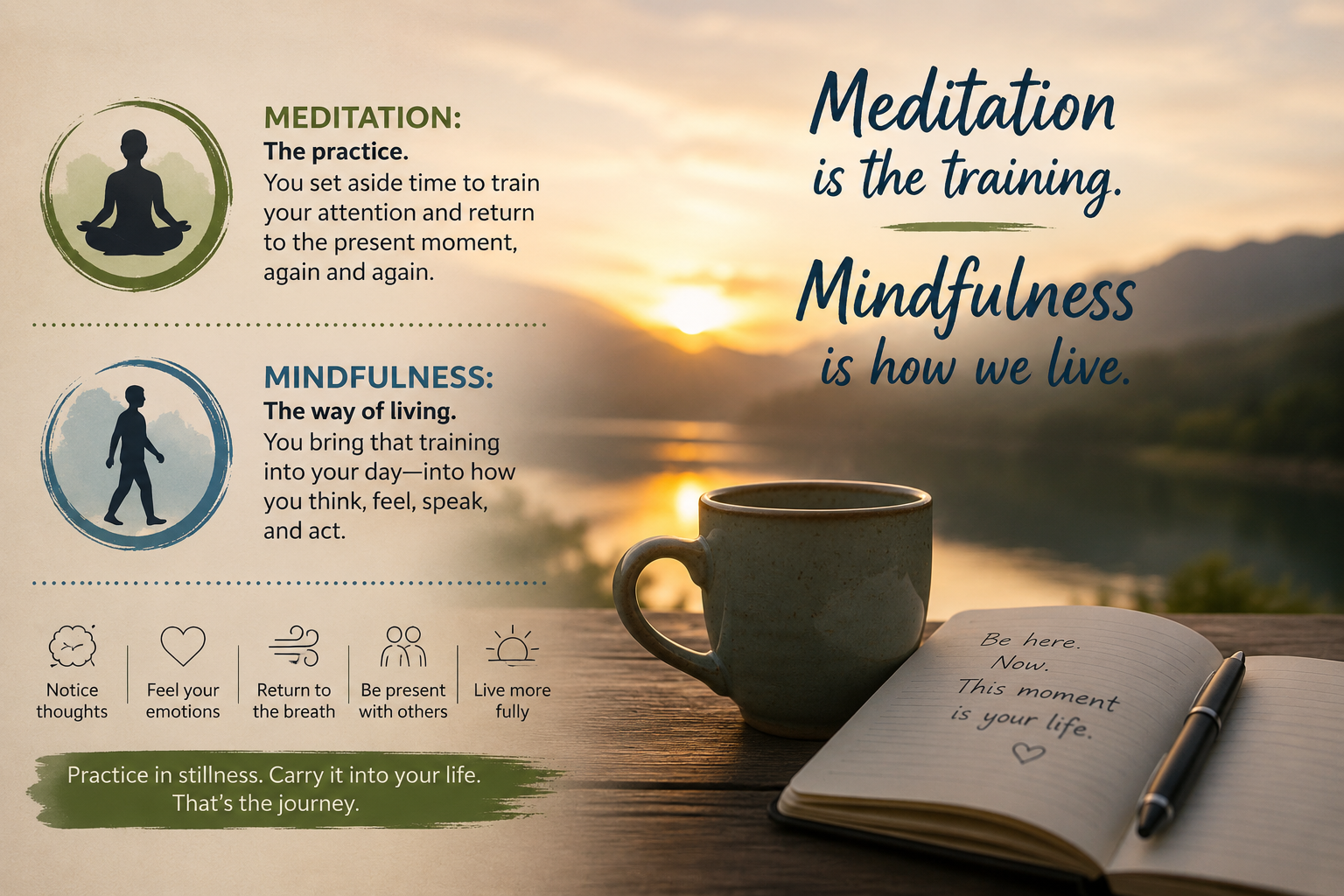
Think of meditation as the practice, and mindfulness as the skill that grows from that practice.
Meditation is when we intentionally set aside time to train our attention—perhaps by sitting quietly and feeling the breath, noticing thoughts as they arise, or becoming aware of sensations in the body. It is a deliberate practice. In some ways, it is like going to the gym for the mind.
Mindfulness is what we begin to develop through that training. It is the ability to be present and aware in our daily lives—to notice what we are feeling, thinking, and doing without immediately becoming lost in it or overwhelmed by it.
During meditation, we practice returning our attention again and again.
Then, during the rest of the day, mindfulness may show up when we pause before reacting, when we recognize that we are becoming stressed, when we actually taste the food we are eating, or when we give another person our full attention during a conversation.
In simple terms:
Meditation is the training time. Mindfulness is how we bring that training into our lives.
I don’t intend to become dogmatic about meditation or mindfulness. There are many approaches, and I don’t believe there is only one “correct” way to practice.
But I do think we sometimes make mindfulness sound easier than it really is.
We hear phrases such as “be present,” “live in the moment,” or “just be mindful.” These are good suggestions, but how do we actually do that?
Our attention is constantly being pulled somewhere else. Phones, television, news, social media, responsibilities, worries, memories, plans, conversations, and our own stream of thoughts compete for our attention throughout the day.
Even when the room around us is quiet, the mind may not be.
This is where meditation becomes important.
Meditation gives us a place to practice.
We sit down for a few minutes and discover something very ordinary: the mind wanders.
We notice it.
We return to the breath.
A thought appears.
We notice it.
We return.
We remember something from yesterday.
We return.
We begin planning tomorrow.
We return again.
That returning is not evidence that we are doing meditation badly.
The returning is the practice.
Each time we notice that our attention has wandered and gently bring it back, we are practicing the very ability we will need later in the day.
Then something happens at work or at home that irritates us. Instead of reacting immediately, perhaps we notice: I’m getting angry.
There is a small space between the feeling and our response.
That space matters.
Or perhaps we notice that we have been worrying about something for twenty minutes. Instead of continuing to follow every thought, we recognize what is happening: I’m caught in worry right now.
Again, there is awareness.
This is mindfulness.
I don’t mean that someone who doesn’t meditate can never experience mindfulness. Of course we can all have moments of natural presence and awareness. We become absorbed in a beautiful sunset, listen carefully to someone we love, or suddenly notice the feeling of the wind against our face.
But there is a difference between occasionally experiencing a mindful moment and developing mindfulness as a more consistent way of meeting our lives.
That takes practice.
And for me, meditation is where much of that practice takes place.
You don’t have to meditate for an hour. You don’t need special clothing, incense, a meditation cushion, or a particular religious belief.
You can simply sit.
Relax.
Feel yourself breathing.
When your mind wanders, notice where it went and gently come back.
Then do it again.
And again.
Over time, perhaps the most important thing we discover is that we aren’t practicing meditation simply to become better at sitting quietly.
We practice sitting quietly so that we can become more awake to the life we are already living.