
By James Brown
There is something extraordinary hiding in plain sight.
It is not hiding in mystical visions or peak experiences. Neither is it waiting for some dramatic breakthrough. It is not somewhere else, and it is not something we have to attain.
It is here!
It is in the ordinary moment you are living right now.
Most of us miss it. We do not miss it because it is rare. We miss it because we are distracted.
We Don’t Actually Experience Our Lives
Pause for a moment and notice what usually happens during the course of a day.
You walk outside, but you are thinking about tomorrow. You sit with someone you love, but you are rehearsing something you should have said earlier. You drink your morning coffee, but barely taste it. You drive a familiar road and arrive with almost no memory of what you saw along the way.
Our bodies are here, but our attention is somewhere else.
The moment itself is simple. The mind is not.
We overlay experience with commentary, planning, remembering, rehearsing, comparing, and judging. Instead of simply seeing what is in front of us, we immediately begin deciding what it means. Instead of hearing a sound, we identify it, evaluate it, and connect it to something else. Instead of feeling an emotion, we construct a story around it.
None of this is necessarily wrong. Thinking, planning, remembering, and interpreting are essential human abilities. The problem comes when we become so absorbed in them that we rarely experience anything directly.
We begin living more in our interpretation of life than in life itself.
Over time, this creates a strange dullness. Days can begin to feel repetitive, flat, and mechanical. We look for something new to make us feel alive again.
But perhaps the dullness is not in the world.
Perhaps it is in our divided attention.
What Happens When We Stop Interfering
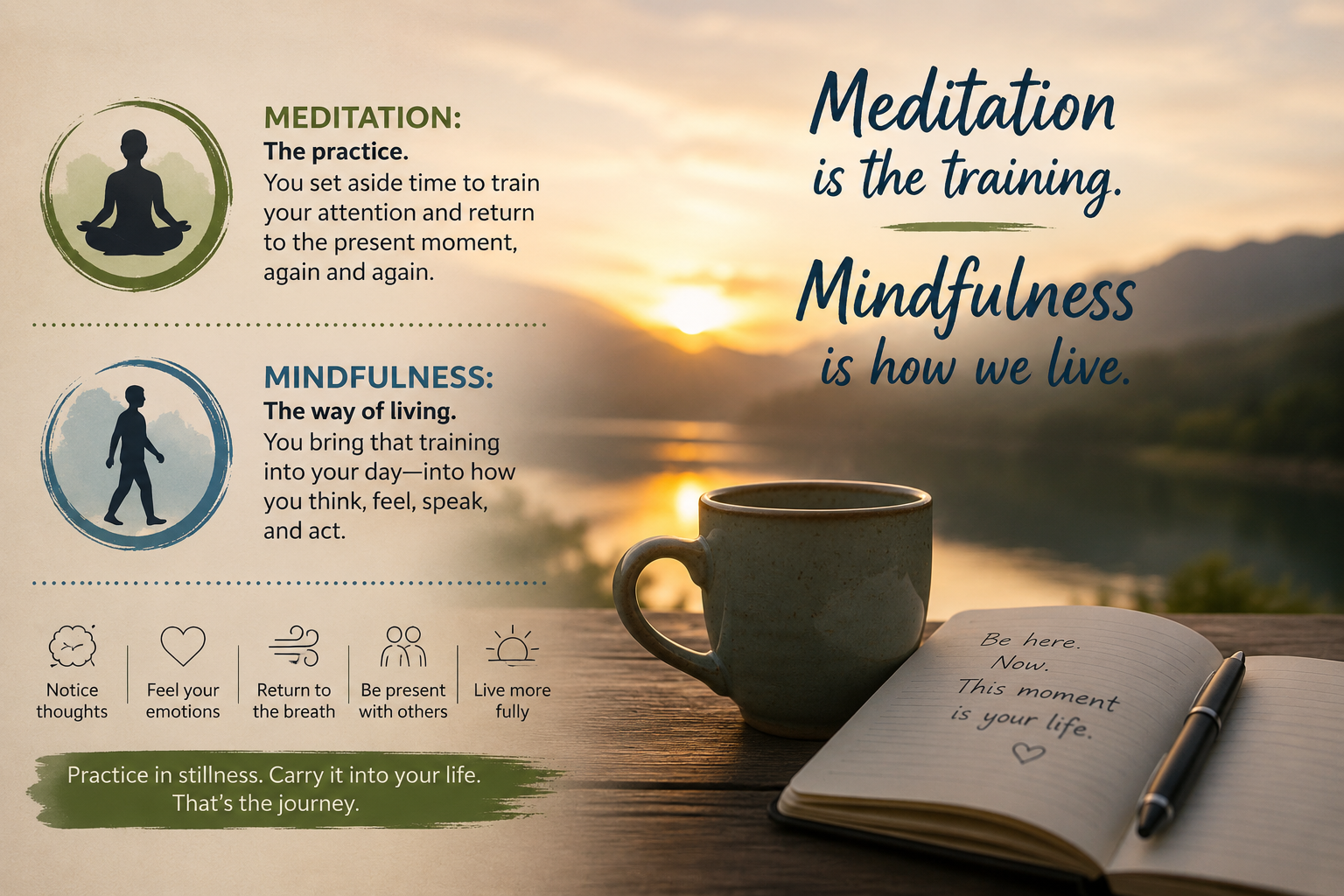
Meditation gently interrupts this pattern.
The practice can be remarkably simple.
We sit.
We relax.
We breathe.
We sit upright and allow ourselves to settle. We feel the body sitting in the chair. We notice the natural movement of breathing. When thoughts carry us away, as they inevitably will, we notice and return.
Nothing needs to be forced.
Nothing needs to be achieved.
At first, nothing dramatic may happen.
That is precisely the point.
Meditation is not necessarily about producing an unusual state of consciousness. It can be much simpler than that. We are learning to stop interfering with experience long enough to actually notice it.
And when we are no longer constantly chasing stimulation, resisting discomfort, or disappearing into thought, something subtle begins to emerge.
Colors may seem sharper.
Sounds become clearer.
Space feels more spacious.
The body becomes more noticeable.
Ordinary interactions can feel warmer and more immediate.
Nothing supernatural has occurred. The world has not suddenly become more interesting.
We have become more available to it.
We have stopped drowning out reality with mental noise.
The World Has Always Been Alive
There is a natural vividness to ordinary experience.
The way afternoon light rests on a wall.
The sound of rain against a window.
The rhythm of footsteps on pavement.
The warmth of a cup held between your hands.
The face of someone speaking to you.
The movement of leaves in a breeze.
The simple dignity of breathing in and breathing out.
None of these things is spectacular. Yet when we are fully present, they possess a richness that is easy to overlook.
This vividness does not need to be manufactured. It does not require a particular philosophy or religious belief. It does not require us to convince ourselves that ordinary things are somehow sacred.
It simply requires attention.
As attention becomes steadier, the world begins to feel intimate again.
And perhaps intimate is a better word than spectacular.
The world does not need to become spectacular.
It becomes close.
We are no longer standing at a distance from our lives, thinking about them. We are participating in them.
There is something quietly powerful about that intimacy.
Why We Miss the Magic
We live in a culture that often teaches us that meaningful experiences must be intense.
We chase novelty.
We scroll.
We search for the next interesting thing.
We escalate emotion.
We move quickly from one experience to another, sometimes before the first one has even registered.
The difficulty is that constant stimulation can numb perception.
Speed flattens depth.
When everything must be louder, faster, newer, or more dramatic to hold our attention, ordinary experience begins to seem insufficient.
But perhaps ordinary experience is not insufficient.
Perhaps our attention has simply become accustomed to being overstimulated.
The quieter dimensions of experience become noticeable only when we slow down enough to encounter them.
This is one reason meditation can feel almost underwhelming at first.
We are accustomed to fireworks.
Meditation offers sunlight.
Fireworks demand our attention. Sunlight does not.
It simply illuminates what is already here.
And sunlight, unlike fireworks, allows us to see the world.
Nothing Needs to Be Added
One of the surprising lessons of meditation is that presence is less about adding something to experience than about removing what obscures it.
We do not have to make the present moment profound.
We do not have to make ourselves peaceful.
We do not have to manufacture wonder.
We simply practice becoming available.
Sit.
Relax.
Breathe.
Feel the body sitting here.
Notice the breath entering and leaving.
Hear the sounds around you.
When the mind wanders into its stories, plans, worries, and rehearsals, notice that too. Then gently return.
Again and again.
Gradually, we may discover that what we were looking for in extraordinary experiences was quietly present in ordinary ones all along.
A cup of coffee.
A familiar face.
A breeze through an open window.
The sensation of our feet touching the ground.
One breath.
Then another.
This is not an escape from ordinary life.
It is a return to it.
And perhaps that is the quiet magic of meditation:
It does not necessarily give us a different life. It teaches us how to be present for the life we already have.